
WYF Meaning in Text & Snapchat: 100+ Slang Terms Explained
WYF means “Where you from?” The sender wants to know your hometown, city, or country. Friends, new followers, gamers, and dating matches all use the question as a quick icebreaker in a text message, a DM, or a comment.
The full WYF meaning still depends on the sender and the message before it. This guide explains every common use, shows how WYF works on each big app, gives you safe replies, and ends with a 100+ term slang dictionary you can bookmark.
WYF quick facts:
- WYF means “Where you from?”
- The acronym has three words: where, you, and from.
- The long form is “Where are you from?”
- Snapchat, Instagram, TikTok, WhatsApp, Discord, and iMessage users send the question in DMs, comments, and group chats.
- WYA, WYD, and WBU are related acronyms with different questions.
What Does WYF Stand For?
WYF stands for “Where you from?”, a short question about your hometown, city, or country. Each letter maps to one word: W is “where,” Y is “you,” and F is “from.” The phrase drops “are,” so the long version is “Where are you from?”
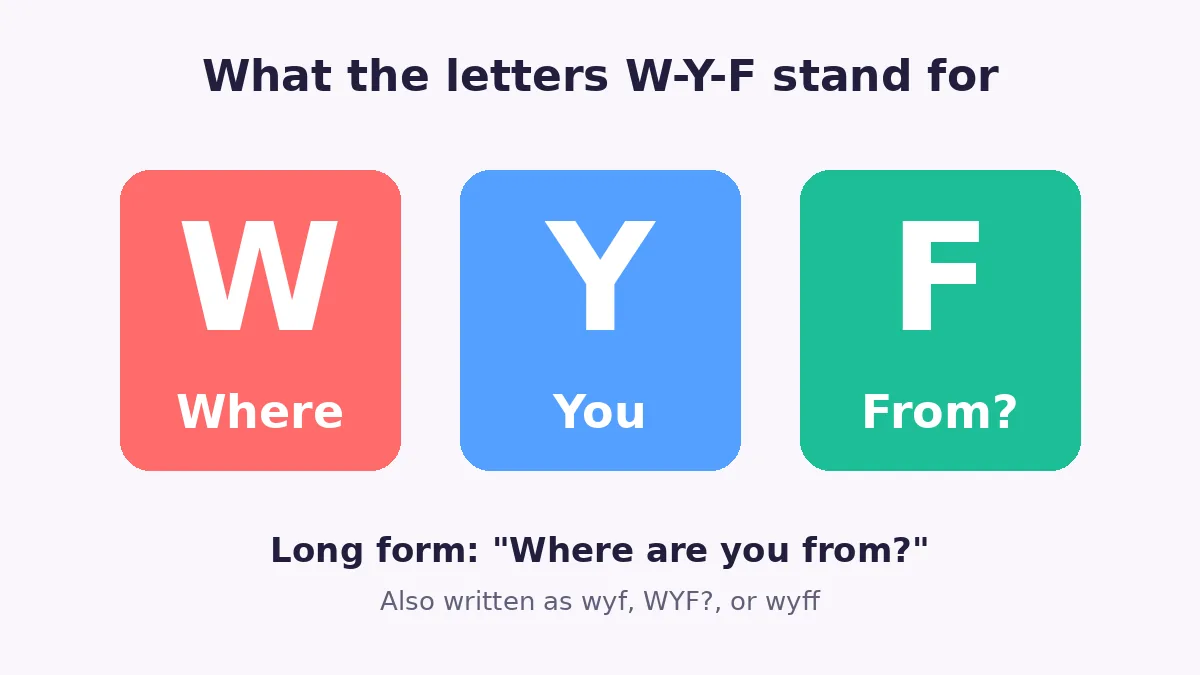
The acronym shortens a full question, so senders usually add a question mark or nothing at all. You will see it written as WYF, wyf, or WYF? Urban Dictionary, the crowd-written slang site, has a user entry for “where you from” dated 2014, and several later entries repeat that definition.
What Else Can the Letters Stand For?
WYF also stands for “What’s your favorite?”, “What you feeling?”, “What’s your feedback?”, and “When you finish?” The context points to the right one. Here are the five versions:
- Where you from? – the default question about location.
- What’s your favorite? – the oldest Urban Dictionary entry, from 2008, uses this one.
- What you feeling? – a friend asks about your mood or what you want to eat.
- What’s your feedback? – a coworker wants your opinion on a draft.
- When you finish? – a friend asks when your shift or class ends.
A few Urban Dictionary entries also list crude versions. Those versions are rare, and a stranger who opens with “hey, WYF?” almost always means the location question.
How Do You Tell Which Version Someone Means?
The previous message tells you which version the sender means. “Just moved here, WYF?” asks about your hometown. “Pizza or tacos, WYF?” asks what you want. A shared document followed by “WYF?” asks for feedback.
Look at the sender next. A new follower usually asks about location, because a stranger has no reason to ask about your lunch or your work file. A close friend at dinner time asks about food. When the message stays unclear, ask “Where I’m from, or what I want?” One short question saves both of you a confusing conversation.
What Does WYF Mean on Snap, Instagram, and TikTok?
The acronym WYF means “Where you from?” on Snapchat, Instagram, and TikTok and shows up mostly in direct messages to new followers. The short form fits these apps because replies are quick and informal. Most people on them prefer two-second questions over long intros.
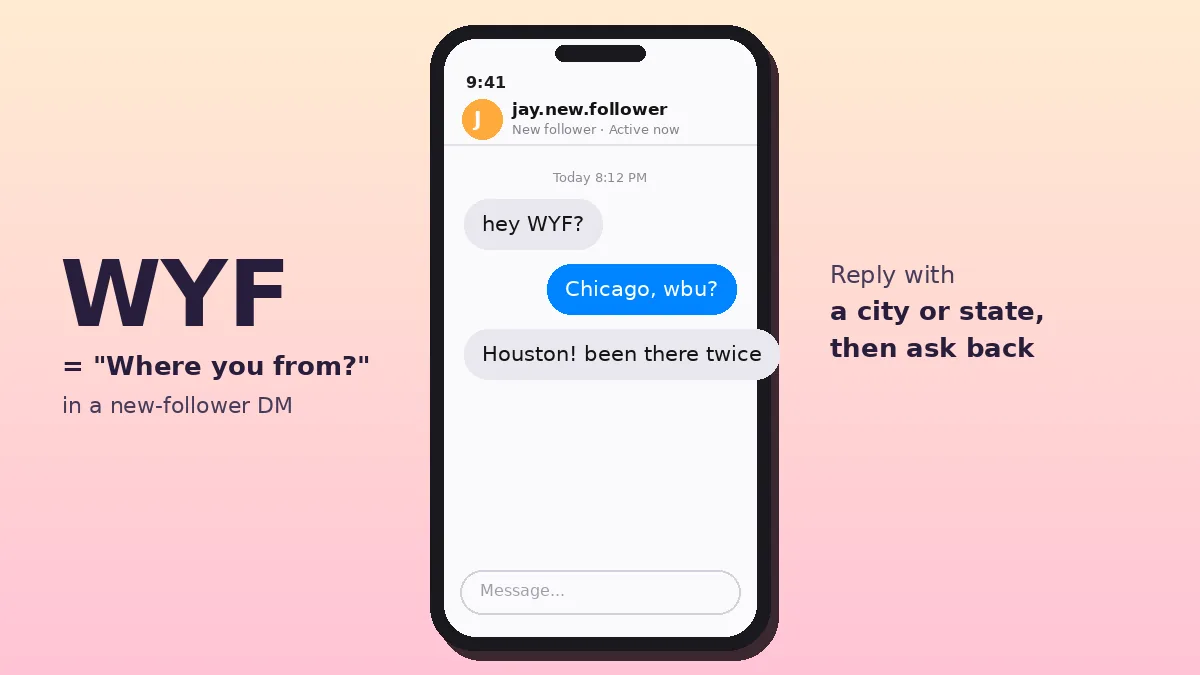
On Snapchat, a user who adds you through Quick Add often sends WYF in the first Snap or message. The question helps both sides decide whether you live nearby. On Instagram, the question shows up in DMs after a follow and in comment threads under travel or city posts. A TikTok WYF comment usually sits under a video with a strong accent, a local food, or a street view, and the commenter wants to know the creator’s city.
How Does “Where You From” Show Up on WhatsApp, Discord, and iMessage?
WhatsApp and iMessage users send WYF in group chats when a new member joins. Discord users type it in gaming servers, where players from many countries team up and want to know each other’s time zone. In every one of these online conversations, the question works as a friendly way to break the ice, not as a demand.
Gaming servers add one more twist. Players often ask the question after a laggy match, because distance from the game server explains a high ping. A reply like “Brazil” or “West Coast” gives teammates the useful part without naming your town.
Is WYF Rude or Flirty?
WYF is not rude. It is a neutral, informal question about where you come from. The tone comes from the sender, the timing, and the follow-up messages. A friendly sender makes it friendly, and a dating match makes it flirty.
From a friend or a new follower, the question is plain curiosity. On dating apps like Tinder, Hinge, and Bumble, the question starts many flirty exchanges, because matches want to know whether a date is possible. The question feels pushy only when a stranger repeats it, ignores your reply, or asks for your exact address next.
Do Girls and Guys Use the Acronym Differently?
WYF means the same thing from a girl or a guy: “Where you from?” A girl who sends it usually wants to know whether you live close or share a hometown. A guy who sends it often wants a quick way to keep the exchange going. Gender does not change the definition; the rest of the message sets the mood.
How Should You Reply to “Where You From”?
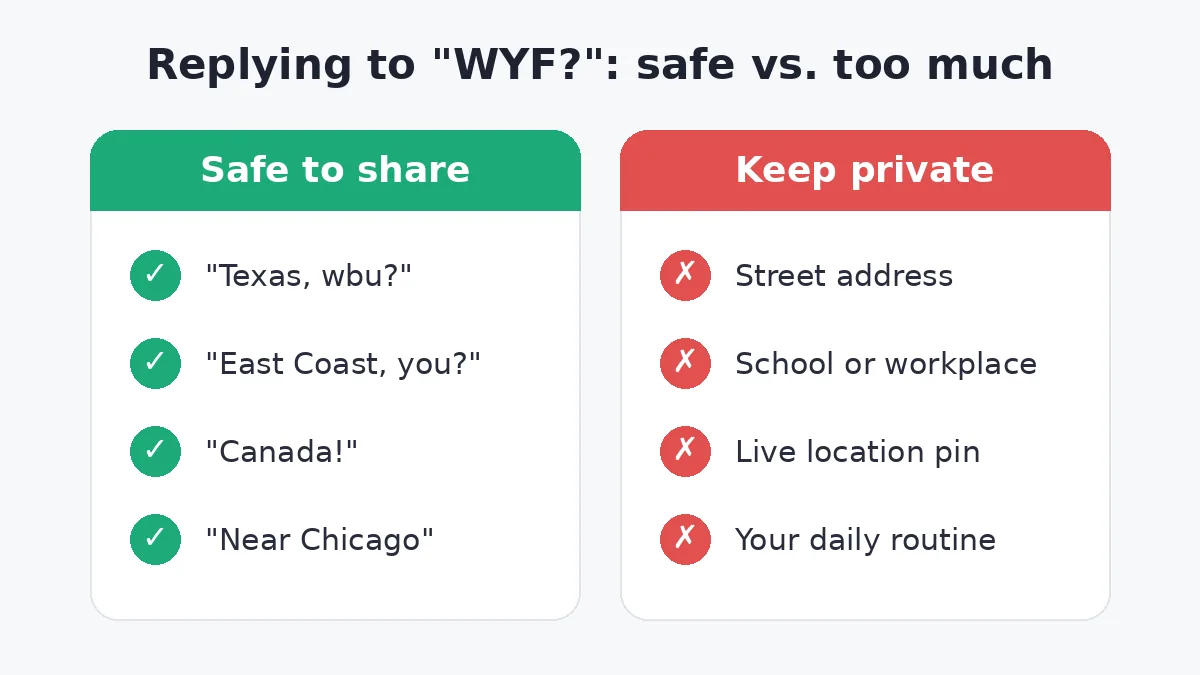
The best reply to WYF names a city, region, or country and asks the question back, as in “Texas, wbu?” A good reply keeps casual conversations moving without sharing private details. Match the energy of the message: a one-word question deserves a short reply, and a warm question deserves a warmer one. Pick a style that fits the sender:
- Simple: “Texas, wbu?”
- Friendly: “Born in Manila, living in Toronto now. You?”
- Funny: “Planet Earth, mostly the couch section.”
- Private: “East Coast. What about you?”
- Curious: “Why, you planning a trip?”
Which Replies Keep Your Location Private?
A region-level reply keeps your location private. Say “the Midwest” or “near London” instead of a street, school, or workplace. Never share your home address, live location, or daily schedule with someone you just met. If a new match pushes for those details after a texting follow-up or two, end the exchange and block the account.
When Should You Ask “Where You From,” and When Should You Skip It?
WYF fits casual messages with friends, followers, gamers, and dating matches. It does not fit work emails, job applications, customer support, or any message to a teacher or manager. The rule is simple: if you would say “hey” to the person, the question works.
- Good fit: a new Discord teammate, an Instagram follow, a Snap from a classmate.
- Bad fit: a recruiter, a client, a formal email.
- Better long form: “Where are you from?” sounds warmer with older relatives and new coworkers.
The most common mistake is mixing up WYF and WYA. WYF asks about your origin; WYA asks where you are right now. A second mistake is overthinking the tone. Most senders type the question in two seconds and expect a two-second reply. A short, honest reply plus a question back is enough, and it signals that you are open to more messages.
What Do Real “Where You From” Conversations Look Like?
A real WYF exchange takes two or three lines: one side asks “WYF?”, and the other side names a place and asks back. Each example below fits a different app:
Instagram DM: “Love your beach pics! WYF?” – “San Diego. You?”
Discord server: “Your ping is crazy, WYF?” – “Germany lol.” – “Makes sense.”
Dating app: “Hey Sam, WYF originally?” – “Ohio, but I moved here last year.”
Group of friends: “Movie or bowling tonight, WYF?” – “Movie for sure.”
Work thread: “Sent the draft, WYF?” – “Looks good, just fix slide 3.”
Every example ends with a reply that keeps the conversation going. That habit turns a two-word question into a real connection on social media.
How Does WYF Compare to WYA, WYD, and WBU?
WYF asks where you come from, WYA asks where you are right now, WYD asks what you are doing, and WBU asks “What about you?” HBU means “How about you?” The table shows the difference:
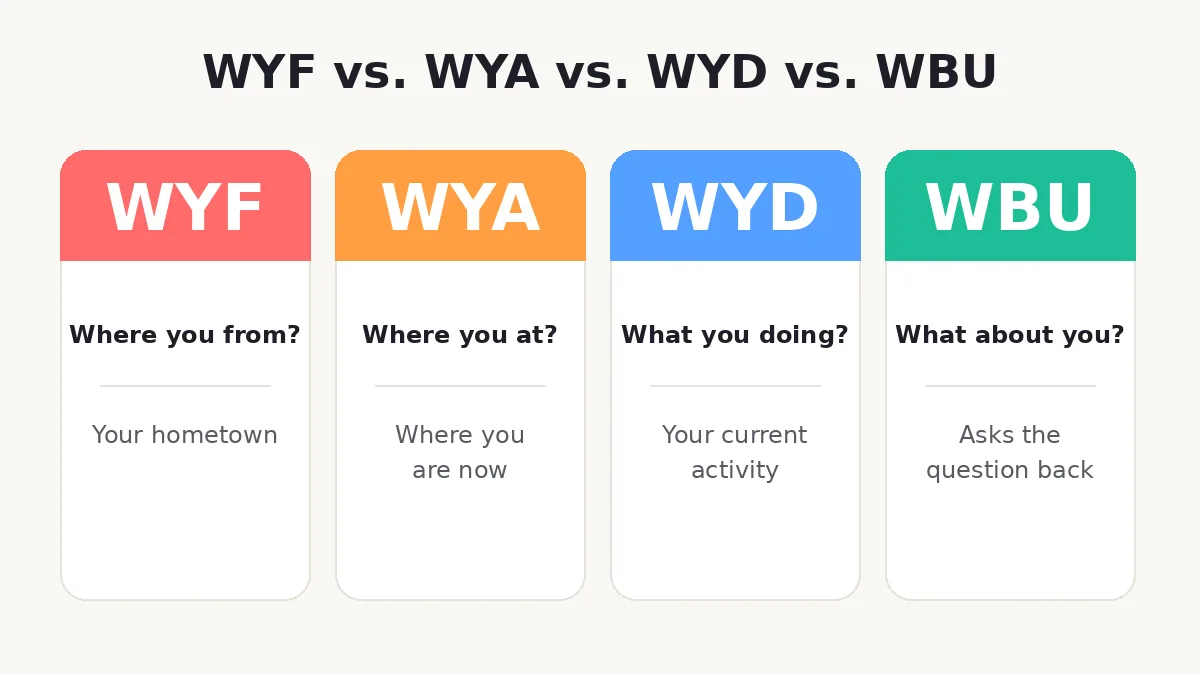
| Term | Stands For | Asks About | Example |
|---|---|---|---|
| WYF | Where you from? | Hometown or country | “New here, WYF?” |
| WYA | Where you at? | Current location | “WYA? I’m at the gate.” |
| WYD | What you doing? | Current activity | “WYD this weekend?” |
| WBU | What about you? | Your side of a question | “I’m from Ohio, WBU?” |
| HBU | How about you? | Your mood or status | “Pretty tired, HBU?” |
The right reply depends on the term. Answer WYA with a place, WYD with an activity, and WBU or HBU with your own news. Mixing them up rarely causes trouble, and the sender usually just asks again.
Which 100+ Texting Slang Terms Should You Know?
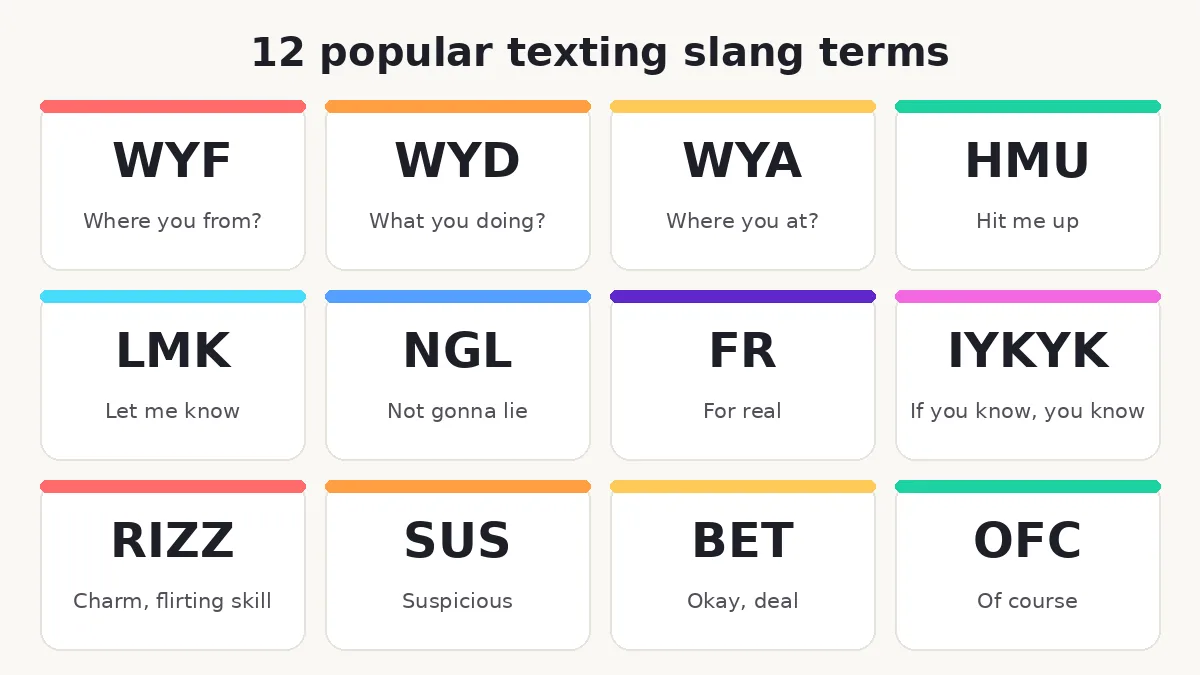
The 113 terms below are the short forms that show up most in DMs, comments, group chats, and gaming servers, from WYD and WYA to RIZZ and IYKYK. Each row gives the term, what it stands for, and a quick example. The list runs from question slang through everyday short forms, social media trends, and dating terms.
| Term | Meaning | Example |
|---|---|---|
| WYF | Where you from? | “WYF? I’m from Ohio.” |
| WYD | What you doing? | “WYD tonight?” |
| WYA | Where you at? | “WYA? I’m outside.” |
| WYM | What you mean? | “WYM by that?” |
| WDYM | What do you mean? | “WDYM it’s canceled?” |
| WDYT | What do you think? | “New logo, WDYT?” |
| WBU | What about you? | “I’m good, WBU?” |
| HBU | How about you? | “Busy day. HBU?” |
| HRU | How are you? | “Hey, HRU?” |
| HYD | How you doing? | “HYD today?” |
| WRU | Where are you? | “WRU? Class started.” |
| WTW | What’s the word? | “WTW for Friday?” |
| WTM | What’s the move? | “WTM after the game?” |
| WYLL | What you look like? | “WYLL? Send a pic.” |
| SUP | What’s up? | “Sup, long time.” |
| WTH | What the heck? | “WTH just happened?” |
| ETA | Estimated time of arrival | “ETA? Food’s here.” |
| LOL | Laughing out loud | “That meme, LOL.” |
| LMAO | Laughing my a** off | “LMAO I can’t.” |
| ROFL | Rolling on the floor laughing | “ROFL at your story.” |
| IJBOL | I just burst out laughing | “IJBOL at that clip.” |
| BRB | Be right back | “BRB, dinner.” |
| BTW | By the way | “BTW, I paid.” |
| IDK | I don’t know | “IDK where it is.” |
| IDC | I don’t care | “Pick any, IDC.” |
| IDEK | I don’t even know | “IDEK what time it is.” |
| IDTS | I don’t think so | “Rain today? IDTS.” |
| TBH | To be honest | “TBH I loved it.” |
| TBF | To be fair | “TBF, he tried.” |
| IMO | In my opinion | “IMO the first one wins.” |
| IMHO | In my humble opinion | “IMHO it’s too long.” |
| LMK | Let me know | “LMK when you land.” |
| TTYL | Talk to you later | “Gotta run, TTYL.” |
| TTYS | Talk to you soon | “Love you, TTYS.” |
| BFN | Bye for now | “Heading out, BFN.” |
| GTG | Got to go | “GTG, bus is here.” |
| OMW | On my way | “OMW, five minutes.” |
| OTW | On the way | “Pizza is OTW.” |
| NVM | Never mind | “NVM, found it.” |
| IKR | I know, right? | “That ending? IKR.” |
| SMH | Shaking my head | “He forgot again, SMH.” |
| TY | Thank you | “TY for the ride.” |
| THX | Thanks | “Got it, thx.” |
| YW | You’re welcome | “YW, anytime.” |
| NP | No problem | “NP, happy to help.” |
| PLS | Please | “Send the link pls.” |
| JK | Just kidding | “You’re fired, JK.” |
| FR | For real | “That was scary fr.” |
| FRFR | For real, for real | “Best tacos ever frfr.” |
| ONG | On God (I swear) | “I saw him, ong.” |
| NGL | Not gonna lie | “NGL, that’s cute.” |
| FYI | For your information | “FYI, the store closes at 9.” |
| ASAP | As soon as possible | “Reply ASAP.” |
| TMI | Too much information | “Okay, TMI.” |
| IRL | In real life | “Let’s meet IRL.” |
| OMG | Oh my God | “OMG, you got in!” |
| RN | Right now | “Can’t talk rn.” |
| ATM | At the moment | “Busy atm.” |
| BC | Because | “Staying in bc it’s cold.” |
| TMRW | Tomorrow | “See you tmrw.” |
| OFC | Of course | “Ofc I’ll come.” |
| DW | Don’t worry | “DW, I got it.” |
| FS | For sure | “Coming tonight? FS.” |
| MK | Mmm, okay | “Mk, see you then.” |
| IGHT | Alright | “Ight, bet.” |
| NBD | No big deal | “Missed it? NBD.” |
| FWIW | For what it’s worth | “FWIW, I agree.” |
| AFAIK | As far as I know | “AFAIK it’s free.” |
| IIRC | If I remember correctly | “IIRC it starts at 8.” |
| HTH | Hope this helps | “Here’s the map, HTH.” |
| TIL | Today I learned | “TIL owls can’t move their eyes.” |
| ICYMI | In case you missed it | “ICYMI, the show is back.” |
| FYP | For You Page (TikTok) | “This hit my FYP.” |
| POV | Point of view | “POV: you’re late again.” |
| TFW | That feeling when | “TFW the bus leaves early.” |
| MFW | My face when | “MFW the bill arrives.” |
| IYKYK | If you know, you know | “That beach, IYKYK.” |
| OOMF | One of my followers | “Oomf just posted.” |
| SFS | Shoutout for shoutout | “SFS? I’ll post you.” |
| TBT | Throwback Thursday | “TBT to summer camp.” |
| WFH | Work from home | “Can’t meet, I’m WFH today.” |
| LWK | Lowkey | “LWK want fries.” |
| HWK | Highkey | “HWK obsessed with this song.” |
| GOAT | Greatest of all time | “Messi is the GOAT.” |
| SUS | Suspicious | “That link looks sus.” |
| CAP | A lie | “He’s rich? Cap.” |
| NO CAP | No lie | “Best pizza, no cap.” |
| BET | Okay, deal | “Meet at 6? Bet.” |
| SLAY | Did amazing | “Your outfit? Slay.” |
| RIZZ | Charm, flirting skill | “He has zero rizz.” |
| DELULU | Delusional | “Thinking he’ll reply is delulu.” |
| STAN | Superfan | “I stan this band.” |
| FOMO | Fear of missing out | “Skipping it gives me FOMO.” |
| YOLO | You only live once | “Booking the trip, YOLO.” |
| BFF | Best friends forever | “Meet my BFF.” |
| GG | Good game | “GG, rematch?” |
| AFK | Away from keyboard | “AFK for 5.” |
| FTW | For the win | “Pizza night FTW.” |
| DM | Direct message | “DM me the details.” |
| HMU | Hit me up | “In town? HMU.” |
| ILY | I love you | “Night, ily.” |
| ILYSM | I love you so much | “Thank you, ilysm!” |
| IMY | I miss you | “Come back, imy.” |
| BAE | Sweetheart, partner | “Dinner with bae.” |
| SO | Significant other | “Bringing my SO.” |
| GF / BF | Girlfriend / boyfriend | “My bf is driving.” |
| DTR | Define the relationship | “Time to DTR.” |
| LDR | Long-distance relationship | “We’re in an LDR.” |
| FWB | Friends with benefits | “Not dating, just FWB.” |
| ASL | Age, sex, location | “ASL? Old-school, lol.” |
| NSFW | Not safe for work | “NSFW, open later.” |
| GHOST | Stop replying without warning | “She ghosted me.” |
| SITUATIONSHIP | An undefined romance | “It’s a situationship.” |
Which Dating Terms Deserve Extra Care?
FWB, DTR, HMU, and WYLL are the dating terms that deserve extra care, because they carry more weight than everyday short forms. Check the mood before you use them. WYLL asks for a photo, and ASL asks for age and location, so treat both like WYF and share only what feels safe. For another dating favorite, see our guide to OFC meaning.
Frequently Asked Questions
Is the “Where You From” Question Rude?
No. The question is informal but polite. The sender wants to know your hometown or country.
What Does the Acronym Stand For on Snap?
On Snap, WYF means “Where you from?” New friends send the question to see whether you live nearby.
Is “Where You From” the Same as WYA?
No. WYA asks where you are right now, and WYF asks where you come from.
Can You Use the Acronym at Work?
No. The acronym is too casual for formal emails and client messages. Write “Where are you from?” or ask for feedback in full words.
How Does Urban Dictionary Define the Acronym?
Urban Dictionary’s most repeated user entry defines WYF as “where you from.” The oldest entry, from 2008, defines it as “What’s your favorite.”
What Does the Acronym Mean in a Chat?
In chats, WYF means “Where you from?” Friends, gamers, and new matches type it to learn your city or country.
What Does WYFF Stand For?
In messages, Urban Dictionary defines WYFF as “What’s your favorite food?” Outside messaging, WYFF is the call sign of WYFF 4, the NBC TV station in Greenville, South Carolina.